Queer Media and You, and U
Edition Nine: A review of Underscores' U, Detransition, Baby, Transamerica, and Strapped
How did lesbian March treat you, Web Surfer?
I might have mentioned that I was trying to launch my secret project before the end of March. Well, March is over and the secret project has not released. In preparation for the project, which is being delayed exactly one month, I’m switching to a different newsletter format. Rather than one newsletter and one essay, you’re going to get one extra long newsletter.
This month, we have a look at how Underscores became Underscores, and a review of some of the queer media I’ve consumed.
U
I’m always curious about the journeys my favourite artists took to stardom. Their oldest work, what’s sometimes known as juvenilia, will often still contain the same ineffable quality that their current work has. PinkPantheress’s earliest songs aren’t amazing, but they still have her ear-tickling vocals. In Harry Styles’ first X Factor appearance, he has his trademark charm and good looks, and his trademark inability to produce music that sounds good.
There’s a lot that unites the artists that make it big. It’s a group of disproportionately talented, hard working, attractive individuals. But not all of them share all those qualities. What truly unites them is that they all got a bit lucky. And the best way to get lucky is to buy a lot of lottery tickets. Create a shotgun blast of art and see if any of it resonates with anyone, which is probably why artists of the digital age have a giant digital footprint. I wonder if Timothée Chalamet ever wishes he could wipe Statistics off the web.
With the release of Underscores’ third studio album, U, I wanted to take a look back at the Underscores juvenilia. Every artist’s early work is crude and somewhat embarrassing, but visiting the early work of a trans artist holds a different weight. She wasn’t yet out as trans for her first EP, when she sang, “I wish my shoulders weren’t so wide, and I wish I wasn’t so terrified.” Oof.
It’s often not that hard to stumble upon an artist’s deadname. I’ve personally found myself in a strange situation: do I scrub the internet clean of my early work that features my old name, even if I’m still proud of it? This month I ran a HTML workshop and I wanted to show off my old portfolio as an example of how my style has evolved, but it was under [my deadname].com. The compromise I settled on was replacing the logo with my current name, and Ctrl+F-ing all the instances of it with Ava. In some ways it’s dishonest, but there are some lies that are more true than the truth.
I knew of Underscores’ 2018 EP, but I was unaware she was in a cute little indie band called Papaya & Friends. It’s actually quite good, especially for songs that have less than ten thousand views on YouTube. It’s very Flamingo-era Kero Kero Bonito, very Wallows-Mac DeMarco-Rex Orange County-indie and very Asian American Middle America. One of the music videos looks like it was filmed remotely. That is all to say, it is extremely, sickeningly, severely 2020. Pouring one out for all the former art hos.
It’s also very Underscores. Every Papaya & Friends music video has this little jingle and a graphic before the video begins. Every description starts with “szn 1”. She had big plans. Underscores understands her art as products, and she understands the marketing as art itself. Her website is immaculate, might I say. On it she lists fishmonger as an album with “10 products, 33m 45s” and U as an album of “9 products, 34m 08s”.
It was only in 2021 she released fishmonger. And only two years after that did she release Wallsocket. It’s kind of remarkable that she went from twee indie to a rock concept album in three years. The immaculate Underscores vibe seems to have been made as Athena was, already fully armed from Zeus’s forehead.
It goes without saying that her latest release, U, is amazing. It’s one part 2020 hyperpop to equal parts dubstep squeals and Timbaland drums. The pop production reminds me of the excesses of K-pop and 2000s Max Martin. But then going back to back with Tell Me (U Want It) and—for example—SexyBack, it feels like wading ankle-deep through the kiddy pool.
My life, reflected back to me
I’ve been thinking a lot about the media representations of “people like me”. I’m not entirely sure what I mean when I say “people like me”. I’m sure everyone feels they are too specific to ever be represented by media, and it’s not just because I’m a Greek-Vietnamese transsexual lesbian. But this month, I’ve been thinking about media about queer media, which is always a thorny subject.
I think I dislike discussions of representation in media for the same reason discussions of the Bechdel test can be frustrating. The test, which asks for “at least two women who have a conversation about something other than a man”, is not a very good proxy for the quality of a movie. Is Emilia Pérez a good movie because it passes the test? Probably not. The Bechdel test is useful only in aggregate, as a tool for analysing the film industry as a whole. What kinds of movies get funding, which voices get listened to, and how do critics react.
One of my favourite films is also one of the worst examples of a trans character on screen. 1975’s Dog Day Afternoon sees Al Pacino play Sonny Wortzik in a bank robbery gone wrong. As the stick-up turns into a hostage crisis and the hours drag on, it’s revealed that Sonny is robbing the bank to pay for his lover’s gender reassignment surgery. It’s a cis man, Chris Sarandon, who plays Sonny’s lover Leon. And Sarandon plays the role more as an effeminate gay man, rather than as a woman. He even has a beard and a short mop of hair.
It’s especially jarring given the film is based on a true story. Someone really robbed a bank to pay for their lover’s bottom surgery, but the lover in this case was an incredibly beautiful, incredibly fish woman named Elizabeth Eden.
I often wish we had a different actor playing Leon, but then there is that heart breaking phone call between Sonny and Leon and I’m less certain. For everything it gets wrong, the film never questions the love between Sonny and Leon. It doesn’t frame Sonny as any more crazy than anyone in love ever is. I wish I could condemn this movie as the kind of ridiculous fare you wheel out to play drinking games with, but it’s not. The movie certainly feels dated, but it’s a little bit too well made to hate, and the theme of love too universal to ignore.
I’ve been in luck to have actually seen myself in some of the media I’ve been enjoying this last month—not just through universal themes, but in the actual works themselves. Sometimes it’s even felt like I’ve had thoughts ripped straight from my brain, or conversations taped from my friends.
Detransition, Baby by Torrey Peters
I was told about Detransition, Baby with the story from the book’s opening chapter: A trans woman who has unprotected sex with a HIV-positive man to simulate the thrill she knows cis women must feel having unprotected sex with men. The thrill that a single night could alter the course of your life forever: in contracting AIDS or falling pregnant. It was with that story I knew I had to read this book.
I worry that even the briefest plot synopsis will misrepresent what this book is about. Yes—on a literal level—this is a story of a former transsexual who unwittingly gets a girl pregnant after assuming his balls had atrophied forever and suggests bringing in his no-contact transgender ex-girlfriend to co-parent the child.
And while the book is thrilling, it’s never quite as zany as that short summary would suggest. The incredible premise of the book serves only to push these very grounded characters to their limits, to see how they will react, like watching bacteria in a petri dish. It is, for example, only at the prospect of being a father that our former transsexual realises he’s less comfortable with manhood than he’d like to admit.
Detransition, Baby is extremely good. I read that there was a TV show in the works that got scrapped last year. “I think Detransition, Baby is dead as a television show. Somebody else might resurrect it, but it was just the vagaries of Hollywood.” I’m not sure how much I trust the Hollywood machine to faithfully adapt the novel. And I’m not sure I’m much looking forward to the TikTok-algorithm-friendly discourse that would emerge following its release.
As you might guess from the opening chapter, this book takes a sometimes unflattering look at the transgender experience. If you believe that good representation requires your characters be good people, as many on TikTok do, then this book is not good trans representation. It is undeniably familiar, however.
There’s a level of nuance that I’m not used to in media like this. The main character that is cisgender is mixed race, and she uses her experiences to push back on some of the narratives that the (white) trans characters express. I’m not used to race and gender being contrasted so deftly. There’s a kind of Socratic dialogue thing going on at some points, without ever feeling academic; probably because all the best scenes are just the three main girls sitting around and bantering.
Anyway, I’ve decided that this book is required reading for being my friend. I gave this book to my mum, which was probably a terrible idea.
Gay-Straight Alliance and Strapped Episode 01, by Sophie Kline
The start of Gay-Straight Alliance is three minutes of girls discussing the minutiae of how they’d like to be introduced. It reminded me of a different show about nothing, a kind of mumblecore Seinfeld.
I suppose I’m looking for my generation’s Seinfeld. I wonder what it was like to have been a young person in New York in the 1990s when Seinfeld was first airing. To have a show about your ordinary life be the biggest thing on television. Watching Seinfeld today, I love how foreign certain social mores are to me. George will just give Jerry a girl’s number who he’s never met. That was a normal thing to do pre-social media. There’s an entire episode about George failing to call his girlfriend because he has to use the phones at a Chinese Restaurant.
The first episode of Sophie Kline’s web series, Strapped, taps into some of this. A show about nothing for the modern era, where queerness can occupy more than just the very special episode; where “not that there’s anything wrong with that” was the most boundary pushing a prime-time TV show could be.
Strapped Episode One is about an eccentric named Twig who is quirky-maxxing so hard they wear their ex’s retainer to remember them. Sometimes a bit of meanness goes a long way in cementing the realism of a work. I don’t think Detransition, Baby would have resonated with me so much if it didn’t feature the same cruel thought patterns that sometimes pop into my head uninvited. But some of the jokes in Strapped felt a tiny bit mean spirited, or maybe the writing wasn’t the cleanest. Still, the GPM (guffaws per minute) was high. I’m looking forward to episode two.
Transamerica (2005)
It was a surprise discovering Transamerica going through my parents’ DVD collection. It wasn’t really a surprise that they owned it: my parents have huge collections of random old stuff they collect in bulk from second hand dealers. I also wasn’t surprised that it’s a movie about being trans from 2005. I was surprised that it was a movie about being trans from 2005, and that I hadn’t heard about it.
The synopsis was tantalising as well. A transsexual woman named Bree, played by Felicity Huffman, is one week out from her bottom surgery before she discovers she has an estranged adult son, and they travel together from New York to Los Angeles without him knowing she’s his mother.
Ava, who has been in this newsletter before, collected a few friends for a watch party. I was hoping Transamerica would be the dumpster fire that Emilia Pérez was. Before it started, I asked the gaggle how offensive they thought the film would be from one to ten. There were some fives and sixes. I thought the cover looked earnest. I said it would be two out of ten offensive.
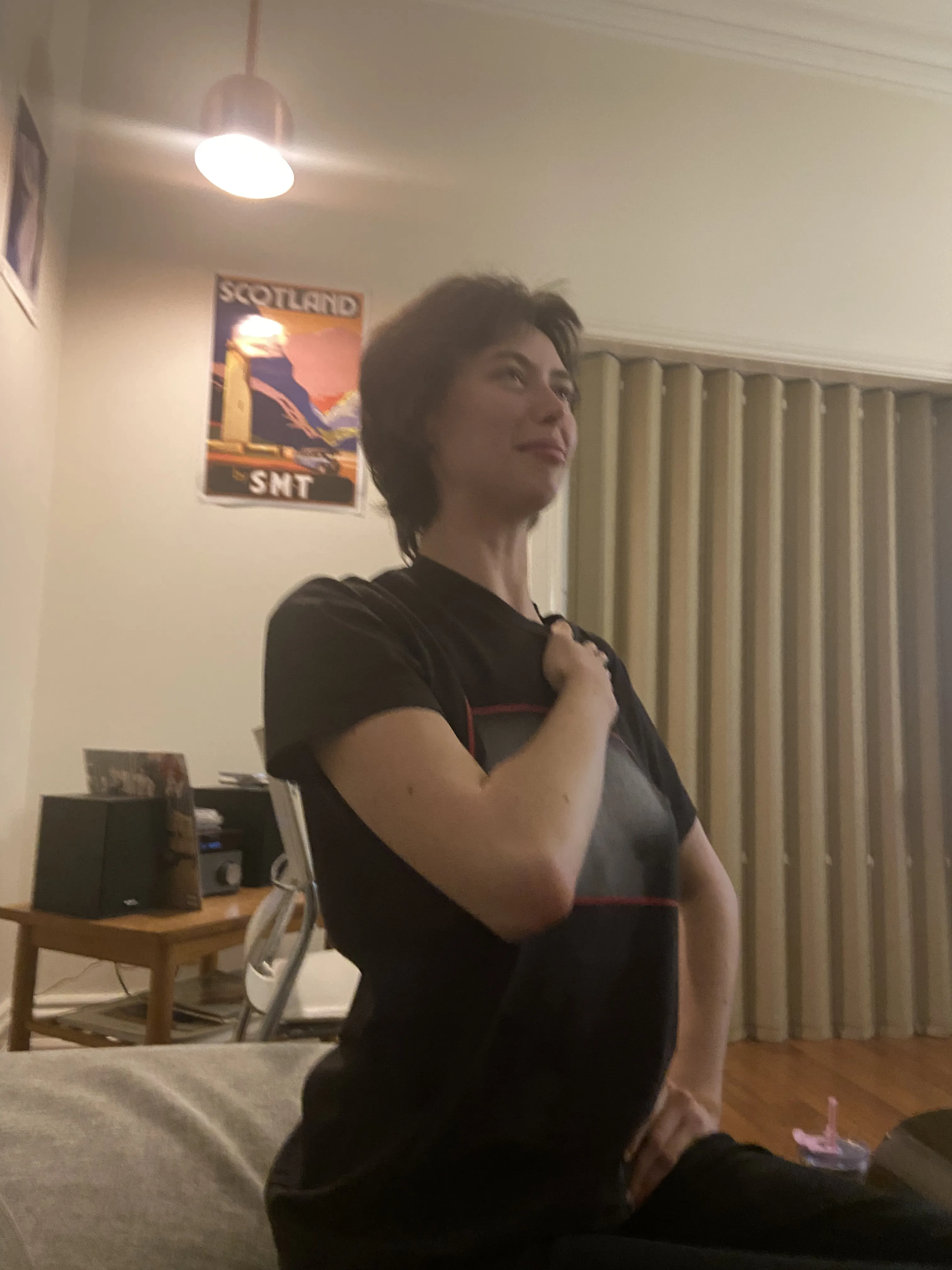
Ava pledging allegiance to the trans. God bless the Pink, White and Blue.
Transamerica is not a dumpster fire. It’s a very competently made movie. That’s probably why I had never heard of it, it’s not bad enough to be remarkable. I was surprised with how much I saw myself in Bree. For everything it got wrong, there were enough specific things it got right. Much like Bree, I would describe my pre-transition relationships as “tragically lesbian.” It’s true that certain anti-androgens can act as diuretics, although I’m not sure any come in oblong blue pills.
Given the evidence of care, it’s all the more strange that it gets certain things so wrong. You might attribute that to the casting: Felicity Huffman is cisgender. One Letterboxd review says succinctly: “Can we please not cast cisgender women as trans women? Thanks.” I have a harder time making firm rules because I’ve watched Dog Day Afternoon, and I know that if a cis woman doesn’t get the role, it’s probably not going to be given to a trans woman. They’ve transed Felicity Huffman up in a kind of fascinating way. She’s constantly wearing too much makeup. Her voice is— I suppose it sounds kind of transgender-y? It’s overly breathy and deeper than Huffman’s normal speaking voice.
Her character is very obviously meant to be someone stricken with near constant anxiety about gender. Her outfits are reminiscent of Jackie Kennedy’s and her manners are overly prim. Clearly, I thought, this film is about someone coming to terms with who they are—dropping the front and becoming the woman she was meant to be, rather than the woman the world thinks she should be.
It’s a beautiful sentiment, and one that is completely absent from the film. Bree does grow into a more complete person, but the necessity of her over-the-top gender presentation is never questioned. The idea that she will finally become a real woman after her surgery is never questioned. I was expecting the movie to feel outdated in its perception of trans women, but I quickly realised that this version of transness is accurate, just to a time and place that I am personally unfamiliar with. Passing for her is not a question of mere dignity, but a question of life and death.
The film could really do with a second trans character to offer an alternate perspective. There are other trans characters, but the representation is a little bit strange. Bree and her son pay a visit to a trans meetup, where Bree declares the group to be a bunch of “ersatz women”. At this point in the movie, she’s still hiding her transness from her son, so it’s ambiguous if she’s being at all sincere or attempting deep stealth. One of these women shows off the dilators for her new vagina. I found some comments from a trans forum from 2006 that put into words why that scene is uncomfortable.
For the non-TS [transsexual] viewer, it gave the impression that transsexualism is a kind of hobby or lifestyle where members get together to compare the new female parts they had installed. It reminded me of when men get together to talk about cars.
There’s two trans women hugging and telling Bree’s son how they met when they were both straight men. When I watched the film I found that scene really sweet, but I can’t help but do a terrible self-cringe. I just wonder if, when the film premiered to a standing ovation in Berlin, that scene would have elicited jeers and laughter from the audience.
Viewing trans people as a hobby is Transamerica’s most glaring flaw, but it’s also a blessing. In the same way Timothée Chalamet can learn ping pong for Marty Supreme to explore themes of class, Felicity Huffman can clockify herself to explore parenthood. The movie works as a movie. It hits all the right notes. I believe all the characters. The acting is good. I liked when Bree was crying at the end and she kept drooling. It felt very real. I found myself chuckling when I was meant to be chuckling. But the film doesn’t have anything interesting to say about being trans.
A New York Times review praises the film for not “slipping too far into … didacticism”. But shouldn’t a film about an underrepresented minority be a little morally instructive? At least instructive enough that a 4 out of 5 star review from the Guardian wouldn’t end with this doozy:
(Incidentally, an agnostic attitude on these issues is traditionally signalled by the journalist sticking to the transsexual’s name and finding ingenious and supercilious ways of not using the male or female pronoun. I can’t be bothered with it.)
And Some More
My Weekend as a 28-Year-Old in Chicago – via Wikipedia
This is the only individual TikTok to have a Wikipedia page.
the html review 05
Should we be doing more interesting things with the internet? Almost certainly. It’s very cool that this wasn’t made with three.js, just buttery smooth CSS transforms.
Tinashe – SEX TAPES
Wow, I can see why this was left unreleased. The world wasn’t ready.
Olivia Offseason
Every album cycle, Underscores posts cryptic tour vlogs on an unknown YouTube account.
Google Search is now using AI to replace headlines
Eek.
Premature Evaluation: Harry Styles Kiss All The Time. Disco, Occasionally
“Don’t worry, James Murphy. This is what it really sounds like when you have no edge.” Oof. I hope Harry Styles sticks around. He’s too much fun to hate.
Crosswords
7 March for Saturday Quiz Time
This cheeky little puzzle was hampered severely because (spoilers) I could not think of a celebrity named Tyrone. I ended up clueing it in relation to Ty Dollar $ign, whose real name is Tyrone. If anyone could think of a more famous Tyrone, please let me know.