When was Australia founded? It’s an interesting thought experiment because unlike the Americans, Australia didn’t violently divorce the United Kingdom. Instead, we gradually, and amicably went our separate ways, without ever actually bothering to sign the paperwork.
The most obvious date is Federation, January 1st, 1901. But Australians would still primarily fly the Union Jack, and we were still not a sovereign nation. So maybe a more appropriate date would be March 3rd, 1986, with the signing of the Australia Act, where Britain finally ceded any jurisdiction within the borders of Australia.
But that date is transparently too late, and clearly Australia was independent before 1986. Maybe you could pick sometime around World War Two? Like the Fall of Singapore, when it became clear Australia could no longer rely on the declining British empire. Less so an independence day, and more when Australia fell out of the nest.
Regardless, it would seem only logical to place Australia’s founding somewhere between 1901 at the earliest, and 1986 at the latest. But I think the historians have it all wrong. I would like to propose an alternate date: the 29th of July, 2008, the day Starbucks announced it would close 61 out of 84 of its Australian stores.
This would be Australia finally coming into its own. In rejecting coffee, we were rejecting American cultural hegemony that at this point had opened a thousand Starbucks stores in China. And in embracing coffee over tea, we were rejecting the British identity that once defined us. This was Australia’s storming of the Bastille, or throwing boxes of tea into Boston Harbour. All because the suits at Starbucks didn’t count on Australia having one ace up our sleeve: Italians.
Starbucks, briefly
To tell the story quickly: Australia is very white for a very long time, only allowing the mass migration of continental Europeans after World War Two. At this point, Australia is a tea drinking society, in line with Britain. Coffee is a thing, but it’s seen as an alcohol alternative served by temperance “coffee palaces”, tasting closer to the coffee drunk in the US today. But the incoming waves of European migrants, namely the Italians, brought with them cafes, and with cafes, espresso.
This was pretty different to the story of coffee in the US. My outsider’s understanding is that coffee there is like tea here: cheap and readily available in office kitchens. I’m picturing those big glass jugs that drip coffee collects in. Starbucks’ big innovation was bringing European cafe culture to the US. When I look at the original Starbucks location in Seattle, Washington, it’s remarkable how unremarkable it looks. There’s about 100 cafes just like it in the Inner North of Melbourne. Starbucks did this while adapting the product to the US palate: “Not so much coffee, as hot coffee-based smoothies”.From Starbucks in Australia: Where did it go wrong? For the record, there’s nothing wrong with a coffee-based smoothie. In fact that sounds delicious. But by the time the first Starbucks opened in Australia in 2000, European cafe culture had already been picked up by mainstream Australia, and strong sugar-syrup-less coffee was preferred.
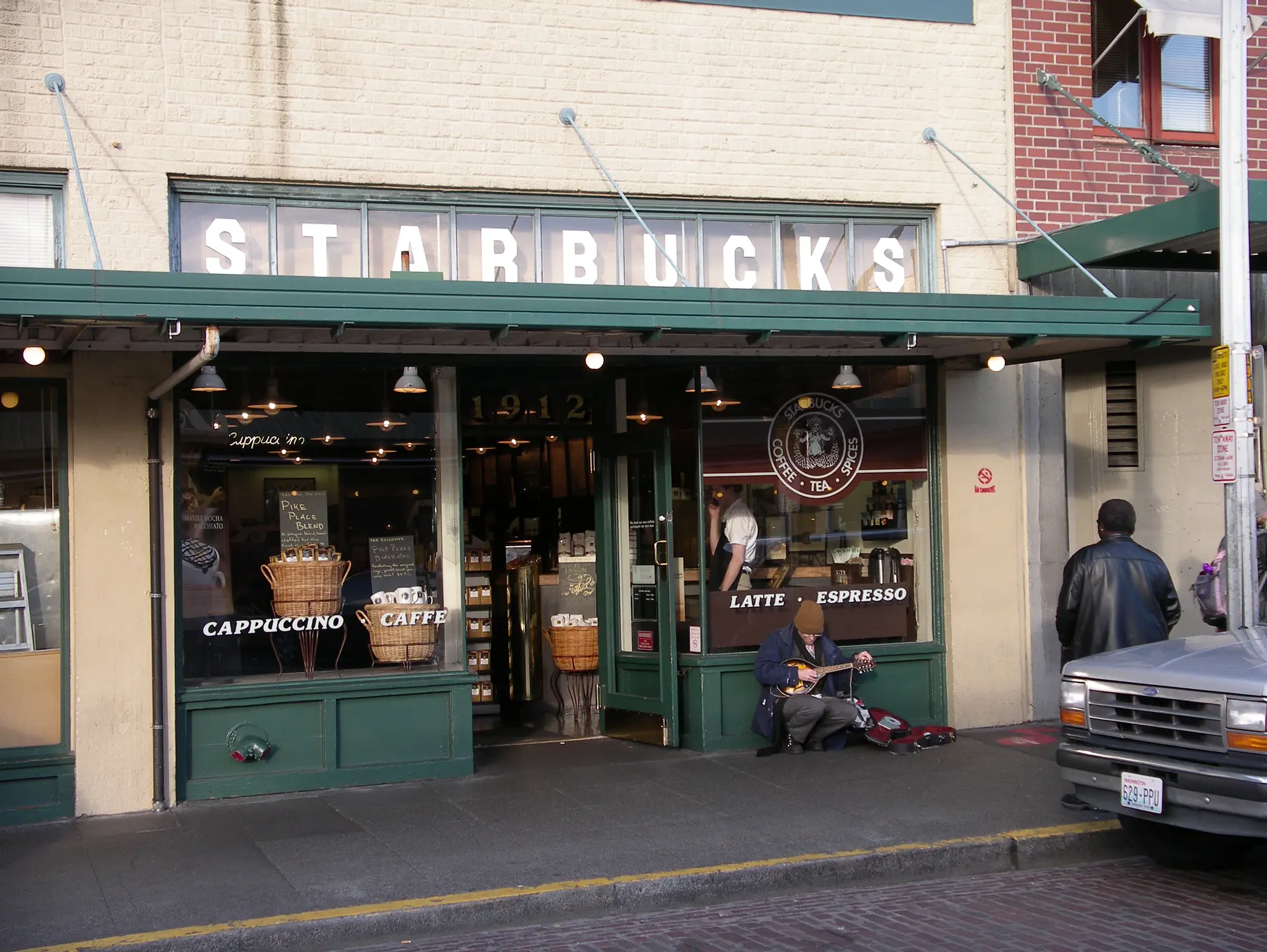
The first Starbucks

There was a lane for Starbucks. People here love sweet bubble tea, and fellow American multinational McDonald’s do amazingly well with McCafé. But both of them trade on a different niche to your local cafe: sweet treats and convenience respectively. Starbucks was explicitly competing with hole in the wall cafes. You don’t need an MBA to figure out why Starbucks failed, but their arrogance was amazing. One of their first stores was opened on Lygon Street, Carlton.
For the uninitiated, Lygon Street has been the heartland of Italian Australian culture. By 2001, when the flagship store opened, Lygon Street had long since been gentrified but it was still a place of historical significance. This was where coffee jumped from Italian migrants, to “trendies”, to mainstream Australians. Its insertion into Lygon Street “was seen by many as cheeky, if not insulting,” to quote the book Trendyville.
Starbucks were strong-arming into the Australian market without letting the consumer grow a liking for it. While this worked in China and the UK, tea is the hot beverage of choice there. In Australia, they were selling a product that wasn’t given a reason to exist. Once the initial hype and curiosity wore off, Starbucks’ profit margins were slipping. They tried to introduce loyalty programs and other gimmicks, but it was too little too late. The closure of most of their stores was mourned by few.
Legacy
There’s a YouTube video from American news channel MSNBC telling this story with over nine million views. In the comment section, there are thousands of Australians proud of expelling Starbucks in Australia. In Trendyville, this pride is explained as inner city yuppies holding on to their ‘terrain’. I would agree, but I would go further. This is myth-making. The international uniqueness of Australian coffee, and the story of how it came to be, quells two of the great anxieties within Australian culture.
Starbucks:
Australia (cheerfully): fuck off, cunt
The recency of multicultural Australia is obvious. ‘Multiculturalism’ was first used by the government in 1973, only three years after my dad arrived from Vietnam. You only need to spend a few seconds in the comment sections of TikToks of archival footage of Australia to see that not everyone has bought in to multicultural Australia. It is genuinely hard to tell who is nostalgic for a time before smart phones, and who is nostalgic for a time before Muslims. Only 63% of Australians agree that Australia is a successful multicultural society, which is a slightly terrifying number.
This percentage would be higher if it wasn’t so easy for them to point to failures of the multicultural experiment. Examples of social cohesion breaking down like the Cronulla riots come to mind, or scenes of immigrants committing crimes. Real or imagined (and I would say mostly imagined), these news stories weigh heavily on the Anglo-Celtic mind.
Positive counter examples are slightly harder to come by. They exist, of course, but they are usually a lot less tangible. There’s a really interesting paper from 2011 called Cosmopolitan nationalism: ordinary people making sense of diversity with interviews from ordinary Australians making sense of diversity. When asked about the benefits of diversity, some interviewees pointed to the hard work done by migrants. Some older respondents said “it mixes up the breeding”. Most people, however, said that diversity enabled them to learn from other cultures.
I think we’re lucky here that we have all the world right in our lap. We can experience the feelings of the people by talking to them, seeing what they wear, and what they eat, and all that. Can go into a restaurant with music and almost feel as if you’re over there … I don’t go to restaurants much, can’t afford it, but I love talking to people.
46 year old Italian interviewee
No matter how hard you try, you simply cannot poke “learning from other cultures” with a stick. So it’s not surprising to me that food was explicitly mentioned by many of the respondents, as the next closest physical stand-in. This is true for coffee, but also for sushi and the banh mi. Even if they’ve been modified for the Australian palate, and in the case of sushi, quite significantly, sharing food is how people bond. “Breaking bread” is used as a metaphor for building community for a reason.
[S]haring food is a central form of cultural exchange and reciprocity. Even if this is in restaurants or at market stalls, it embeds the benefits of immigration in people’s everyday life like little else.
Judith Brett and Anthony Moran, in Cosmopolitan nationalism: ordinary people making sense of diversity
It’s always funny talking to older Australians about the food options they grew up with. Sometimes it feels like they are talking about the Middle Ages. But the love of exotic food does reveal the other insecurity that has persisted in Australian society since the First Fleet: the so-called ‘cultural cringe’. It makes some sense that a nation that was founded by criminals, that so thoroughly rejected the cultures of its Indigenous peoples, feels some uncertainty about its cultural identity. When someone asks what Australia’s national dish is, there’s that awful instinctual wince I do when I have to wheel out the chicken parma or the meat pie. Not that I don’t like the taste of meat pies, but there’s this longstanding belief that Australian culture, and the food therein, is inherently inferior to the rest of the world’s. This perception isn’t helped by so much of what is uniquely Australian being low culture. Just look at our public holidays: we have one dedicated to footy (Grand Final Day), one dedicated to gambling (Melbourne Cup), and another dedicated to drinking (Australia Day).
The coffee culture here is one of the few examples of something that is both uniquely Australian and sophisticated. Beyond its flavour, coffee has utility.
New Australia
Why was it that Americans never adopted Italian coffee culture, despite the huge number of Italian-Americans? Probably because Italian immigration to America predates the invention of espresso. In general, American multiculturalism is much older than Australia’s. In fact, I would argue that there’s never really been a time before America was multicultural. From the moment Europeans started colonising the continent, there were Spanish, British, and French settlers, the Indigenous peoples, and the West African slaves who were violently forced along with them.
This is despite the fact that I never hear Americans talk about multiculturalism. I don’t even think Americans are aware just how multicultural they are, probably for the same reason a fish doesn’t realise it’s in water. Every great American cultural export, from Hollywood movies, to Jazz, to Rock, to the hamburger, came from a fusion of cultures. Even the most stereotypical white bread American is really a German-Irish-English-Swedish-French-Spanish-Jewish-Italian-American. Rather than multiculturalism, Americans usually speak of the melting pot.
Compare that to Australia: we have a multicultural present, but a unicultural past. It is entirely possible to separate the contributions of white Australia from the contributions of ethnic Australia, and racists do this all the time to great effect.
This is the virtue of the melting pot—combining culture into something distinct and inseparable. Coffee was given to Australia by Italian migrants, but once it got here it was adapted to local tastes. Unlike Italian espresso – which is often served black and drunk at the counter – Australian espresso is usually served with milk, which gave way to the invention of the flat white and the magic.
The melting pot metaphor has its detractors. Progressives here don’t like it because it implies a reduction in culture, that immigrant culture is being boiled down in the process of assimilation. And they’re not wrong, this is very much what happened in my family, with my bilingual parents, and their monolingual children. For them, becoming Australian was synonymous with losing some of our ancestors’ culture, which makes me incredibly sad.
I can only truly claim Australian culture as my own, which is something I have in common with white Australia. The anxieties that they have, I share. But I sometimes feel like I’m the only one actually interested in doing something about it. When I first read the essay that coined ‘cultural cringe’, it was so eye-opening that it was almost lurid. But A. A. Phillips wrote it in 1950, and I’m not sure that much has changed in the 70 years since its publication. All culture is, to some extent, artificial. Those same Italians who left for America, would later influence the “authentic” cuisine in Italy itself, in a phenomenon known as the Pizza Effect. As the story goes, pizza was once synonymous with focaccia and flatbread, before Southern Italian emigres re-exported pizza to Italy.
Apparently thick, unsliced sushi is not a thing in other countries. There is a shop selling this “Australian-style” sushi in New York, which did lead to Alex Mark, the shop’s owner, getting called a coloniser and accused of cultural appropriation. I don’t want to overstate this, because it does seem like it was just a bit of Murdoch media culture war nonsense, but this kind of cultural appropriation is probably okay. It’s okay to let go of a bit of authenticity, and let ourselves create a culture of our own. There have been “Australian-style” cafes popping up globally, selling “Australian-style” breakfast; combining British, Mediterranean, Asian foodstuffs. It would be a worthwhile exercise in cultural richness to willingly invent a new Australian culture. And I think we should start with the breakfast menu.
One more thing
Also, it should be noted that Starbucks’ failure was just as much about the 2008 financial crisis as it was about the Australian palate. It also wouldn’t really be completely accurate to say they failed in Australia. They did incur huge losses, but there are now 89 stores here which is more than there were in 2008. They’ve changed tack, opening seven stores in Melbourne’s CBD, including two on Elizabeth Street. They also have lots of stores scattered around suburban shopping centres, but a conspicuous lack of them in the inner suburbs. Despite their success, Starbucks are yet to reopen on Lygon Street.